MaP Students Win R600,000 Prize in Quiz Championship

X

[cs_content][cs_section parallax=”false” style=”margin: 0px;padding: 45px 0px;”][cs_row inner_container=”true” marginless_columns=”false” style=”margin: 0px auto;padding: 0px;”][cs_column fade=”false” fade_animation=”in” fade_animation_offset=”45px” fade_duration=”750″ type=”1/1″ style=”padding: 0px;”][x_image type=”none” src=”https://www.maruapula.org/wp-content/uploads/2017/02/NSQC.jpg” alt=”” link=”false” href=”#” title=”” target=”” info=”none” info_place=”top” info_trigger=”hover” info_content=””][cs_text]

During the weekend starting Friday, 2 December 2016, Maru-a-Pula students Tshepang Dipholo (U6), Dimpho Gosenyang (UM6), Daniel Kgautlhe (UM6),  and Kayanthieni Panchalingam (L6K) travelled to Johannesburg, South Africa for the National School Quiz Championship (NSQC).

”The journey was long, but it posed a wonderful opportunity for us to become better acquainted with one another. We spent our time on the bus quiz sparring, occasionally awed by the picturesque scenery. We were all excited and optimistic about the competition. Above all, we hoped to make our school and nation proud, particularly since we were the only school from Botswana that qualified.

Upon arriving at the Pearson Institute, we met scholars from across the SADC region. We were enthused to learn about different education systems, cultures, and ways of life. During the introductory gala, we took photographs and interacted with the students, sponsors, and producers of the competition. The most memorable event was the treasure hunt. The first prize recipients were team Alpha Phoenix, which comprised of Maru-a-Pula School, Baobab International School (Zambia) and Simba International School (South Africa). It was an exhilarating and intellectually stimulating experience for all of us.

The first round of the quiz completion took place on Sunday 4th. It was a challenge which ended with only sixteen of the 23 schools proceeding to the next round. Questions were based on a broad range of subjects including general African knowledge, world geography and history, mathematics, science and technology. We made it to the top sixteen, top eight and finally the top four teams. With every step, we moved closer to our goal and the level of difficulty rose. We had to be diligent, resilient, meticulous and strategic. In the end, we attained the third position, winning a bursary worth R600, 000 and books from the Thabo Mbeki Foundation.

The trip taught us the profound meaning of teamwork. We learned to work hard and strive for excellence. We also learned that in being different, team members complement one another, bringing out the best in each individual. According to our coach, Mr Solomon Basele, “The competition came at an opportune time for our school, as we can now see that academic sport bears fruit.” Mr Basele added that he is looking forward to even greater support from the school’s administration with regard to academic sports.

Special thanks to Mr Wilson, Mr Matshiya, Mr Phetso, and teammate Kaone Chere (U6), who was unable to make it to the competition.”

~ Dimpho Gosenyang (UM6)

 [/cs_text][/cs_column][/cs_row][/cs_section][/cs_content]
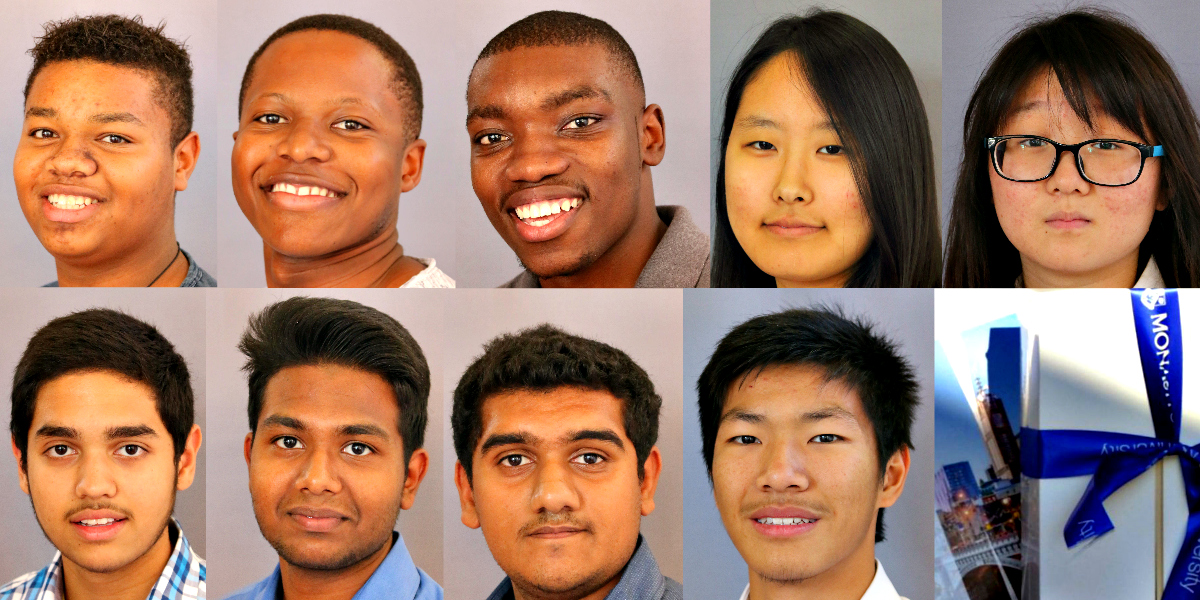
Top (from left): Ethan Jennings, Elwin Kirigiti, Lefika Otisitswe, Ga Ram Park, and Shuyu Jiao Bottom (from left): Anubhar Awasthi, Thomas Thomas, Saigopal Rangaraj and Wen Jiao
Top (from left): Ethan Jennings, Elwin Kirigiti, Lefika Otisitswe, Ga Ram Park, and Shuyu Jiao
Bottom (from left): Anubhar Awasthi, Thomas Thomas, Saigopal Rangaraj and Wen Zhang

On the 22nd September, nine MaP scholars received Apple devices from Monash University’s Science, Technology, Engineering and Maths (STEM) competition. In June, the students entered the annual challenge, in which they had to identify a community issue and invent a device to solve it.   

The U6 team of Ethan Jennings, Elwin Kirigiti and Lefika Otisitswe received I-Pads for their first place Cattle Detection Tag. Saigopal Rangaraj, Thomas Thomas, and Anubhar Awasthi (L6L) tied for second place with Ga Ram Park (5L), Shuyu Jiao (5M), and Wen Zhang (5K). They were all awarded I-Pods for their Heart Rate Monitor and Hour Glass Lamp respectively.

‘’Our invention is a response to road accidents caused by stray livestock on Botswana’s roads,’’ said Elwin. ‘’We figured out a way to use current livestock identification tags and developing technologies to make our system effective. We are elated that our idea won and believe that it’s one to be taken up in future.’’

~ Morongoa Mosetlhi


‘’Maru-a- Pula school will foster the ideals of citizenship, social responsibility, and a lasting commitment to service, both by encouraging an understanding of international, national and community issues, and by involving the pupils in practical acts of service to the community in which the school is situated.’’

~ extract from the original MaP constitution, 1972

Naledi Feeding is one of approximately twenty community outreach services currently run by Maru-a-Pula School. Its main aim is to reach out to and care for the inhabitants of Old Naledi ward in Gaborone, many of which are living in abject poverty. Through this activity, Maru-a- Pula students go to Old Naledi every Monday from 2pm to 3pm to deliver food hampers.

Supervised by MaP Physics teacher, Mr Japheth Otiende, the students go door to door delivering the hampers, which contain 2.5kg sugar, 2.5kg maize meal, 5kg sorghum meal, 200g canned fish, 400g canned baked beans, a loaf of bread and a bar of soap. Mr Phetso Kgosana, who is one of Maru-a-Pula’s longest serving members of staff, prepares the hampers for students to deliver. During school holidays, when students are not available, Mr Kgosana makes the deliveries himself.

Currently, there are eighteen households who benefit from the programme. The households were identified by social workers based on their needs. Most of them were chosen because the inhabitant is an elderly person who takes care of multiple orphans. The remaining households are occupied by people living with disabilities that prevent them from caring for themselves.

The families benefitting from the programme are grateful to have been adopted into the initiative. In the past, lack of human interaction and limited time in the area has prevented the students from being able to ascertain the exact needs of each family and identify more households that could benefit from this initiative. However, students have proactively faced these issues, electing to visit the residents in smaller groups and sourcing sponsors to contribute to the programme.

The Naledi Feeding service has had an immensely positive effect on students and beneficiaries alike. It has enriched their lives, providing them with a sense of community and Botho (respect for one another). Students partaking in the activity feel blessed to have access to the resources that are available to them. Being of assistance to the residents of Old Naledi has reminded them how fortunate they are.

To get involved with Naledi Feeding or to find out more about Maru-a-Pula School’s Service Program, please contact the Director of the SPE Department, Mr Arlington Matshiya on 391 2953 ext. 201 or at spe@maruapula.org.

~ Phenyo Phuu

MaP RAds

On the 15th August, the MaP Refugee Advocates (MaP RAds) travelled to Dukwi Refugee Camp to donate books and solar lights, and facilitate a life skills session. Upon arrival, the warm welcome from the community made it hard to believe the depth of its struggles. Despite the extreme heat, music and children’s laughter filled the air.  On the surface, Dukwi’s residents seem content and well-adjusted. It is only through carefully chosen words that one is able to learn of their fight for freedom. Never the less, the resident’s gratitude remains genuine, as they are at least able to live in peace.

‘’It was an experience I will never forget,’’ said Layla Mutoka (4M). ‘’While we were there, I came across several refugees laughing and smiling. It was unbelievably heart-warming.’’

Located 180km northwest of Francistown, the camp is surrounded by thick rolls of white sand, towering palm trees, enormous Baobabs and thickets of wild grass. The camp is separated into sections made up of traditional mud huts and one-room homes, where its inhabitants reside. The camp’s centre is made up of schools (pre-school, primary and secondary), a police station, clinic, office buildings for administration and NGOs based in the camp, and a handful of general dealers and tuck-shops. These small shops are owned and managed by members of the community, along with farmland where, subject to available resources, they grow poultry and vegetables.

‘’Our tour of Dukwi was a fantastic opportunity to see how much the camp provides for its refugees and how much work is still needed to give them a good standard of living,’’ said Kevin Nigarura, a Princeton in Africa Fellow at MaP who accompanied the students. ‘’We met residents in their homes, and saw neighbourhoods and play areas within Dukwi. We also saw the classrooms MaP students painted last year, but they were no longer in use due to funding cuts.’’

During a briefing session with the Acting Settlement Commandant Mr Fortune Majingo, MaP RAds learnt that the majority of refugees residing in the camp are Somalians. Other residents come from various African countries including Eritrea, Namibia and Congo. The administration provides housing, food, water, health care, security and education to residents through the Botswana government in partnership with organizations such as Red Cross and Skillshare International. However, recent pressure on the economy has led to the decrease of aid available to the camp. In particular, the United Nations High Commission for Refugees’ (UNHCR) withdrawal from the camp, and the reduction in the amount of vocational training offered by Skillshare International, have resulted in the camp’s management relying solely on the government for support.  

Dimpho Gosenyang (L6M): ‘’Having heard many rumours and read several negative articles about the camp, I harboured some misconceptions about it and the refugees. It seems there is more to being a refugee than the name and the confinement – there is hope of a better world.’’

The most eye-opening aspect of the trip was the life skills session with Dukwi’s primary school students, which was broken into two parts. The first was a discussion on children’s rights, in which the students articulated a clear understanding of what their rights are, and how they can prevent them from being violated. The second component was a library book scavenger hunt, which was designed to cultivate positive attitudes towards reading and research amongst the students.

‘’In the few hours that we spent with the students, we all developed a bond with each of them,’’ said Katlego Paakanyo (L6J). ‘’We saw them grow and mature in confidence and we definitely left them with hope that there is life for them beyond the refugee camp.’’

To get involved with MaP Refugee Advocates, or to learn more about Maru-a-Pula School’s service program, please contact the Director of the Service, Physical and Enrichment (SPE) Department, Mr Arlington Matshiya on 391 2953 ext. 201, or email spe@maruapula.org.

~ Morongoa Mosetlhi


goa16-2

From the 27th – 29th August, MaP students Kaelo Tibe (5J), Ahsante Puso (4K), Tumelo Bowie (4M), Leitse Mtonga (4L) and Iman Hosseini (4M) participated in the first Giants of Africa Top 50 Basketball Camp to be held in Botswana. The three-day camp took place at the newly established University of Botswana sports arena. The initiative aims to use basketball to enrich the lives of African youth and provide quality facilities, gear and coaches to develop the sport within the continent.

The quintet was selected as part of the top 50 youth basketball players in the country and trained by top NBA and local coaches. The coaches imparted knowledge and skills that will allow the participants to compete internationally, including ball handling, scoring and passing techniques.

‘’At the end of the camp, we wanted the top 50 basketball players to have developed sharp basketball techniques and be more competitive,’’ said Project Director Pallab Sarkar. ‘’We are aiming to have a Botswana basketball team that will qualify for the 2024 Olympics.’’

Over a decade ago, President of the Toronto Raptors, Masai Ujiri, realized that there was an abundance of talent in Africa. However, he knew that these players would be considered raw and inexperienced if they were to try and compete internationally. In 2003, with the goal of changing this reality, he founded Giants of Africa in his homeland of Nigeria. He spent the next decade fine-tuning the program before it was implemented in Kenya, Ghana and Rwanda. In 2016, with a proven record of success in four countries, the camp’s organisers expanded its reach to include Senegal and Botswana. In addition to nurturing talent, the initiative also supports various outreach programs across Africa, including the Mpule Foundation in Botswana and The Village of Hope in Ghana.

‘’Encouraging the dreams of African youth is at the core of what we strive to achieve with Giants of Africa,’’ said Ujiri. ‘’We believe supporting the infrastructure of basketball in Africa is imperative to creating opportunities for African youth to play and develop skills both on and off the court.’’

To date, more than 100 camp attendees have received scholarships to attend high school or university in the United States, with approximately eighteen participants now playing basketball professionally in Europe. An estimated 55, including Ahsante Puso and Kaelo Tibe, have attended the NBA’s Basketball Without Borders program in Africa.

‘’I am deeply honoured to have had the opportunity to improve my skills as a player,’’ said Kaelo Tibe. ‘’I have a strong passion for the game, and will be using the knowledge I gained to improve my techniques and grow as a leader.’’ 

Giants of Africa camps are made possible through the support of partners from across the globe including the NBA, Nike, and Nestlé Milo. In Botswana, the camp is supported by the Ministry of Youth, Sport and Culture in partnership with the Botswana National Sport Commission, and Botswana Basketball Association.

More details on Giants of Africa can be found at www.giantsofafrica.org.

~ Morongoa Mosetlhi

Dr Medupe demonstrates the Temalo Code game


Maru-a-Pula School alumna Dr Dithapelo Medupe (’04) has earned a place in Botswana’s entrepreneurial history for inventing an educational game based on the interpretation of ditaola (divining bones used by traditional healers). Medupe, who is currently on internship at Letsholathebe Hospital in Maun, visited MaP on 15th September to demonstrate how the game works.

In 2010, during an African Practice course at Stanford University, she realized that she could use binary code to make ditaola speak any language that uses the alphabet. Having seen her grandfather use ditaola in her formative years, Medupe had no trouble cracking the code of the centuries-old practice. By 2014, she had accomplished her goal of creating an African Scrabble, naming it Temalo Code and Decode in honour of her grandfather.

‘’You use the African bones to write words using the mathematics of computers,’’ said Medupe. ‘’Other players memorize a key to decoding the word and they use their memory to crack the word you have written for them.’’

The African bones are square, wooden chips engraved with West African hieroglyphs. Ditaola are sacred to traditional healers; understanding their symbolism is a divine gift. The word can be determined by the coder or derived from general knowledge flashcards. This allows for the game to be used as edutainment across a wide range of subjects. The game tests memory, vocabulary and spelling, while introducing children to the basic computing concepts of binary coding and decoding.

Above all, Temalo Code and Decode celebrates our African heritage. The game has been endorsed by linguistics professor and coding expert Dr Joseph Tsonope, who feels that the game is more advanced than the modern binary coding system, and should be implemented across schools in Botswana. Tsonope also recommended that the game be played by children ages twelve and above.

Dr Medupe recently presented her invention to the Ministry of Education. She challenges the Maru-a-Pula student body to play the game and suggest ways in which it can be improved. Furthermore, she hopes that her MaP alumna status will inspire the students to invent something of their own one day.

‘’MaP led me to Stanford, which led me to my invention,’’ she said. ‘’I am the first Motswana to invent a unique, mathematical board game, and it’s all thanks to MaP!’’

The game can be ordered in Botswana for P450 by sending a message to: https://mobile.facebook.com/TemaloCode. This version is hand-crafted by a combination of local carpenters, printers and tailors. In the UK and US, it is available for $30 plus shipping from https://www.thegamecrafter.com/games/temalo-code-and-decode. Funds raised from sales will be put towards the development of a mobile application for the game.

 ~ Morongoa Mosetlhi


MaP principal David Matthews 1992


Former MaP Principal David Matthews (above, talking with students at the 1992 20-year school anniversary celebrations), who was head of the school between 1981 and 1990, has been awarded a Gold Eagle Award from St John’s College  in recognition of his lifelong service to education.


Mr Matthews will receive the prestigious Gold Eagle Award in South Africa on the 16th of July during the St John’s Gaudy Day celebrations. As part of the ceremony, he will share some of the highlights of his career to encourage students to consider teaching as a career. The Gold Eagle Award honours St John’s alumni, affectionately known as Johannians, who have made a truly significant contribution to South African society. Mr Matthews, who was both a pupil and teacher at St. John’s, will receive the award in recognition of his contribution to education. Gaudy Day commemorates friendships and memories made at the college and is filled with sporting, social and cultural events. 


Mr Matthews joined St. John’s College as a day scholar in 1944. After matriculating in 1953, he continued at the school as a sixth form student where he discovered a passion for education.


‘’It was during my Sixth Form year that I decided that teaching was to be my career,’’ said Mr Matthews. ‘’I went to Wits to do a BSc majoring in Pure and Applied Mathematics.’’


Mr Matthews’ legacy did not end there. In 1972, he and his family would join Dean and Dot Yates in laying the ideological foundations that would become Maru-a-Pula today. He played an integral part in school life, teaching three subjects, overseeing the Boys Boarding House and the kitchen before returning to St. John’s in 1977 to head up their Sixth Form Department. In 1981, two years after the death of his wife Estella, Mr Matthews returned to Botswana with his family to be the head of Maru-a-Pula. Over the next ten years, his legacy would grow to include building Maitisong and developing the service program.


After retiring from MaP, Mr Matthews moved to Vryburg to assist in raising funds to get Tiger Kloof up and running again. After years of hard work, the school re-opened in 1995. Having re-married in 1996, he would work tirelessly, as he did at MaP, before retiring in 2001.


‘’When I retired from Tiger Kloof, I was given a visitorship to Deerfield, Massachusetts where Hilary and I spent a remarkable year,” Mr Matthews said. “This was for me the climax of my career as a schoolmaster and it was great that Hilary and I could share in it.’’

Current MaP Principal Andrew Taylor says, ‘’Matthews was a superb listener and master consolidator. He embarked on an ambitious building programme to accommodate an enrolment which increased from 266 to 400 students while the number of full-time teachers doubled.’’


We congratulate Mr Matthews on his achievement and thank him for his contributions to the Maru-a-Pula legacy.


~ Morongoa Mosetlhi


Three MaP Students go to Hong Kong Maths Olympiad 2016
Three Maru-a-Pula students, (above, left to right) Ga Ram Park, Joel Binu and Kabo Mosetse, have travelled to Hong Kong to represent Botswana in the 57th International Mathematics Olympiad, which will feature “the brightest secondary school mathematics talents from over 100 countries and regions”.

This follows the success of Ga Ram and two other Maru-a-Pula School students, Yiwen Lai and Amrit Amar, who have all placed in the top 100 contestants in the South African Mathematics Olympiad, 

Ga Ram also took part in the 56th International Mathematics Olympiad in Chiang Mai, Thailand, last year. The contest takes place on 11 and 12 July. Each day, students are given three problems in up to two languages of their choice. You can try problems from previous competitions by clicking here.


MathsOlympiadFinalists2016Maru-a-Pula School students (left to right, above) Yiwen Lai, Ga Ram Park and Amrit Amar have all placed in the top 100 contestants in the South African Mathematics Olympiad, and will participate in the final round on July 27th. The competition is organised by the South African Mathematics Foundation, “a non profit organisation aiming to advance the mathematics development and education of South African children and young people through improved quality teaching and learning of mathematics as well as through public awareness activities.”


Ga Ram also took part in the 56th International Mathematics Olympiad in Chiang Mai, Thailand, last year.


Map Marimba Tour 2016


“If someone were to ask me to describe happiness in just a few words, I think saying the “Maru-a-Pula Marimba Band” would be the most fitting of answers… some of the most exhilarating and joyous music that has ever touched my ears.”

~ Nicholas Taborsky, Milton student


Starting in New York City and finishing in Boston, the MaP Marimba Band played 23 concerts in just 16 days and conducted numerous workshops for 18 schools and colleges.  Audiences responded with unhinged dancing delight, forming conga lines, surrounding band members on stage and roaring for encores.


The New York area itinerary included visits to Avenues School, Tuxedo Park, Riverdale, Hudson Cliffs and In-Tech Academy.  As we traveled up through New England we stopped at Williams College, Putney, Deerfield, Hotchkiss, Loomis-Chaffee and Taft.  In the Boston area we played at Groton, St. Mark’s, Brooks, Milton, Harvard University, Roxbury Latin and Sharon Middle School.  


The band visited the 9/11 Memorial Museum, took a Big Bus tour of lower Manhattan, saw the Broadway show, An American in Paris, attended a reception in their honour at Botswana’s Embassy to the United Nations, enjoyed a guided tour of the Juilliard School and shopped till they dropped at many of New England’s finest malls.


Band leader and innovative composer, Laone Thekiso, led 11 of MaP’s most talented marimba players: Nicolaus Nshoya, Tshepang Lenkopane, Teto Mokgachane, Gobopa Mojaphoko, Tyra Molosi, Unami Ntsuke, Yame Leinaeng, Nicole Tsiane, Ludo Bonyongo, Leloba Jefferis and Jenny Yu.  In his Peolwane magazine review, former Maitisong Director, David Slater praised band members as “accomplished young musicians who play with the most infectious verve.”


Thanks go to our Music HOD, Celine Matthee, for her meticulous handling of the planning, logistics and finances of the tour. Several AFMAP Directors helped make the tour a huge success: Antoinette Quarshie coordinated the generous hospitality of Riverdale staff, parents and students throughout our time in New York City; Wendy Davies and Walter Johnsen donated our Broadway show tickets; Sue Heywood and Andy Jackson coordinated a superbly planned visit to Tuxedo Park while Phil and Susan Smith attended to all our needs in Williamstown.  We are particularly grateful to Carolyn Stafford of Syracuse, NY, and Scott Tarantino of Sharon, MA, who made it all possible by loaning us their superb marimbas!


This was my fifth marimba tour and it’s always one of my favourite activities.  I usually drive one of the vans, introduce the band and explain that we are raising funds for the MaP Orphan & Vulnerable Children Scholarship Fund.  This year’s MaP’s marimba band members were superb ambassadors for MaP and Botswana; they exuded joy and generated enormous goodwill throughout an arduous tour.  Well done and PULA!


~ Andrew Taylor, Principal